Introduction
State Medicaid long-term services and supports (LTSS) programs are built on a simple premise: assess what a person needs, then fund the services that meet those needs. In practice, the assessment piece has been a fragmented, inconsistent, and difficult-to-modernize element of LTSS administration.
Across the country, states use dozens of different assessment instruments. Some were built decades ago, well before population analytics, person-centered planning, and data-driven policy became operational expectations. Many capture just enough to determine eligibility but not enough to guide care, measure outcomes, or benchmark populations. In most states, the tool used for an aging adult looks nothing like the one used for a person with an intellectual disability, even if both are funded through the same Medicaid waiver infrastructure.
Originally developed as an international research initiative and now deployed in national healthcare systems across Canada, Australia, New Zealand, and Europe, interRAI is a family of clinically validated assessment instruments. One of the organizing principles of interRAI is to have a unified data framework for all populations, all settings, and all transitions of care. In the United States, momentum is building. States evaluating their assessment infrastructure, particularly those serving I/DD and aging/disability populations, are increasingly asking the same questions: What exactly is interRAI? How does it work in practice? What would it take to implement?
This article answers those questions directly. It is written for LTSS leaders, including directors of waiver programs, aging and disability program administrators, and state Medicaid officials, who are either evaluating whether interRAI is right for their program, or who have decided to move forward and want to understand what implementation looks like on the ground.
What Is interRAI?
interRAI is not a single assessment tool. It is a nonprofit international research consortium, founded in 1992, that has developed a coordinated family of assessment instruments covering the full continuum of care: home and community, long-term care facilities, acute care, rehabilitation, mental health, palliative care, pediatrics, and intellectual disability services.
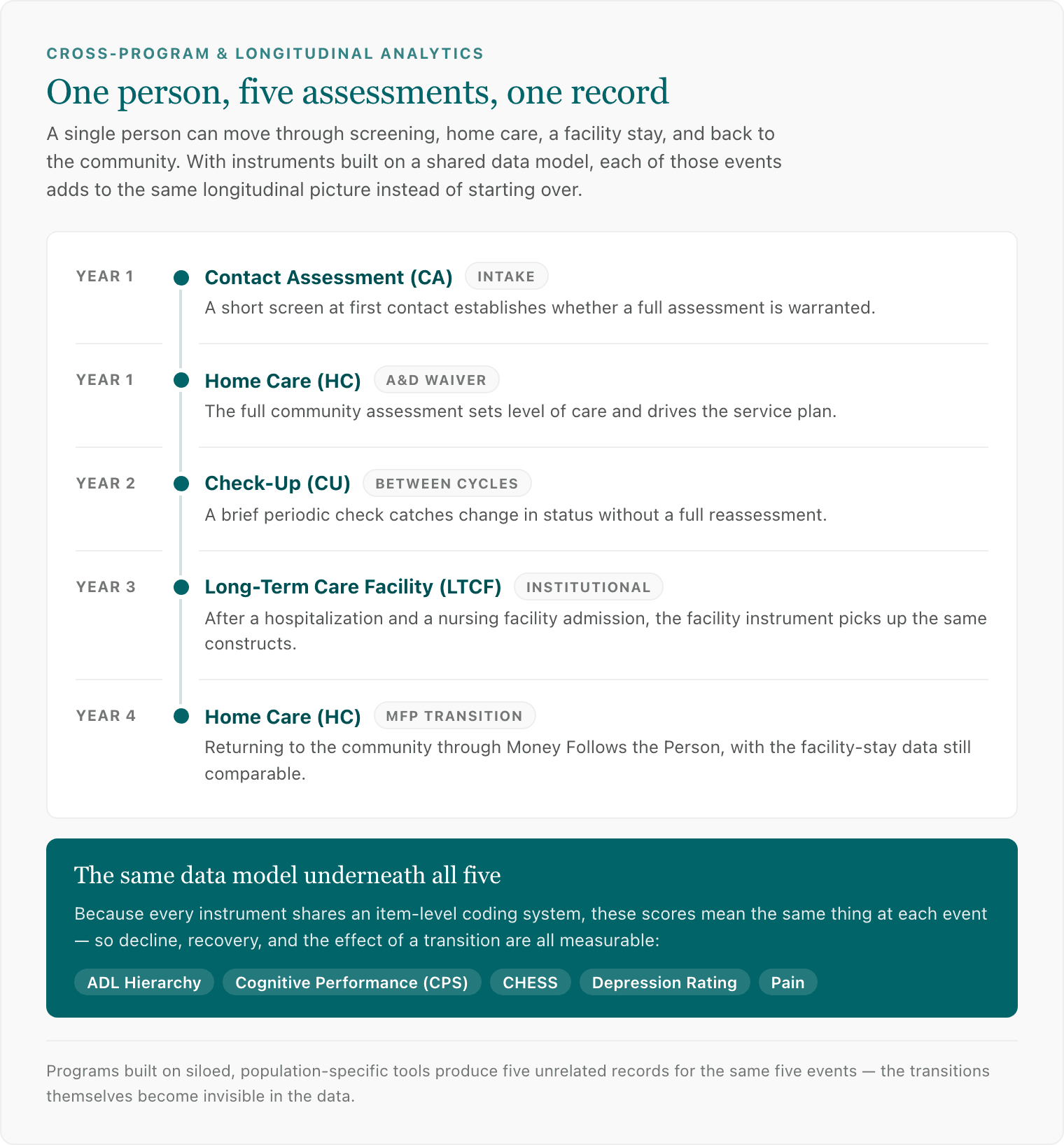
The instruments share a common design philosophy. Every interRAI assessment is built around the same underlying data model and item-level coding system, which means data collected in one setting can be meaningfully compared with data from another. A person assessed in a nursing facility using the Long-Term Care Facility instrument (LTCF) and then transitioning to home-based services assessed with the Home Care instrument (HC) will be described using consistent constructs, scales, and outcome measures, even though they are now in a different program.
This cross-setting design is the central architectural decision that makes interRAI different from assessment tools built for a single population or a single program.
The instrument family includes, but is not limited to:
- interRAI Home Care (HC): The flagship community instrument for adults receiving home-based services. Used in New York’s Uniform Assessment System (UAS-NY), the largest US deployment of any interRAI instrument, and the national standard in Canada. Covers cognition, mood, behavior, activities of daily living, continence, diagnoses, pain, skin integrity, medications, and service use.
- interRAI Intellectual Disability (ID): Designed for adults with intellectual and developmental disabilities in community, residential, and institutional settings. Captures support needs, strengths, preferences, functional skills, behavior, health, and social context, integrating the health and clinical domains that tools like the Supports Intensity Scale and ICAP do not fully address.
- interRAI Child and Youth Mental Health – Developmental Disability (ChYMH-DD): For children and youth with developmental disabilities and co-occurring mental health needs. A critical instrument for states building out children’s HCBS waiver infrastructure.
- interRAI Contact Assessment (CA): A short screening instrument designed for initial contact with a person who may need services. Triggers fuller assessment when warranted.
- interRAI Check-Up (CU): A brief periodic check-in tool for people receiving ongoing services, designed to identify changes in status between full assessments.
- interRAI Community Health Assessment (CHA): A lighter-touch comprehensive instrument for lower-acuity community populations, appropriate for eligibility screening in aging and disability programs.
- interRAI Long-Term Care Facility (LTCF): For nursing home and residential care settings.
- interRAI Community Mental Health (CMH): For adults with serious mental illness receiving community services.
- interRAI Home Care for Child and Youth (HC-CY): A newly released pediatric home care instrument, broadening interRAI’s reach into children’s HCBS populations.
Each instrument is developed through a rigorous peer-reviewed process involving interRAI Fellows, clinicians, researchers, and policy experts from member countries. interRAI research spans more than 40 countries and thousands of peer-reviewed publications. The full interRAI instrument catalog is available online.
How interRAI Works: CAPs, Scales, Case Mix, and Quality Indicators
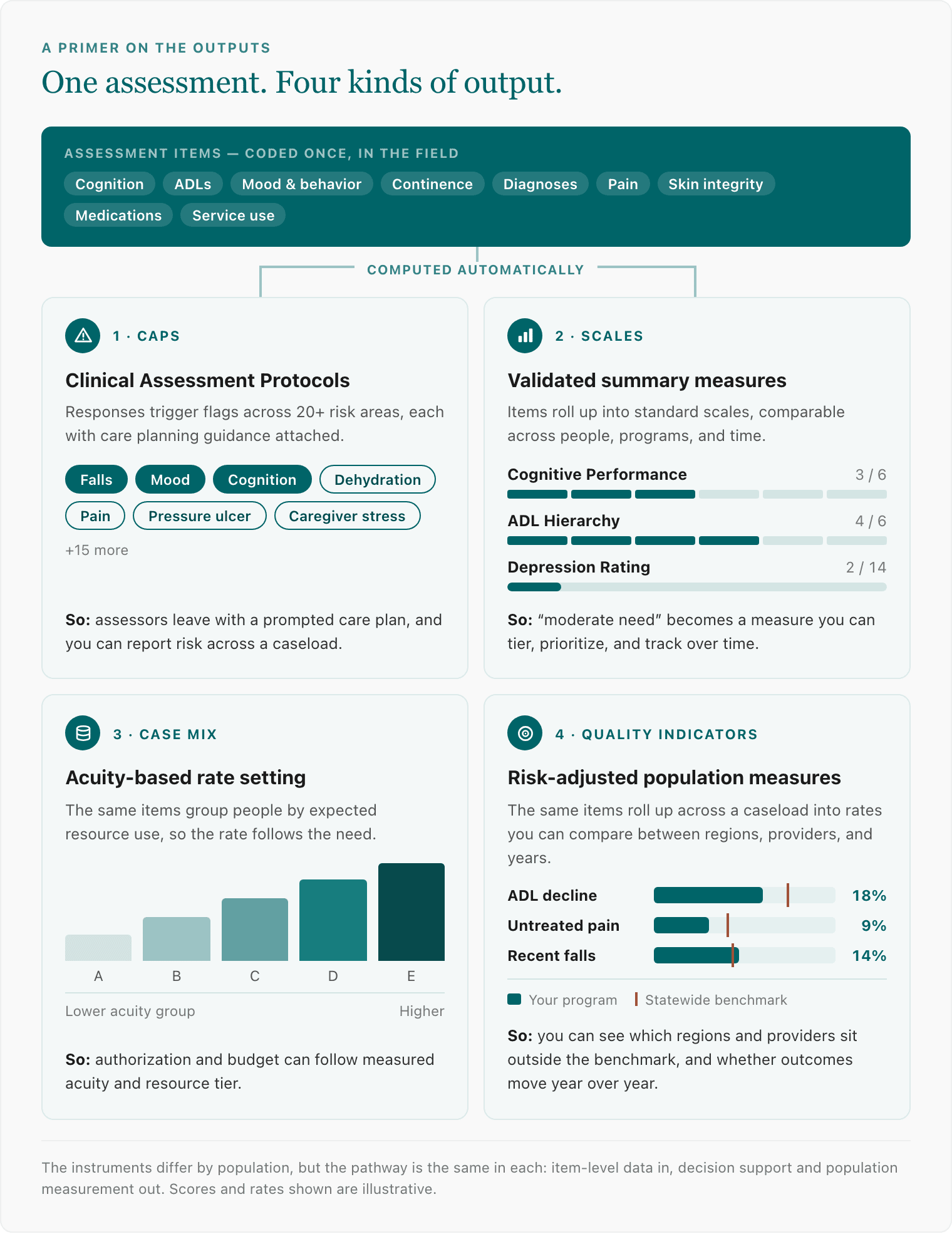
Understanding interRAI requires understanding the outputs it generates, because the assessment items themselves are only the beginning. What makes interRAI clinically and administratively useful is what happens after the data is collected.
Clinical Assessment Protocols (CAPs)
Clinical Assessment Protocols, or CAPs, are algorithm-generated clinical flags embedded in interRAI instruments. When a person’s assessment data meets a defined pattern (a combination of items that research has shown to indicate a specific clinical risk), the CAP triggers automatically, signaling that the assessor and care planner should pay attention to that domain.
The interRAI HC instrument includes 25 CAPs covering domains such as falls, dehydration, mood, cognitive loss, pressure ulcers, pain, appropriate medications, and informal caregiver support. The interRAI ID instrument includes seven CAPs built for the I/DD population: Abuse by Others, Communication, Continence, Injurious Behaviour, Meaningful Activities, Mental Illness, and Social Relationships.
CAPs are not diagnostic. They do not tell a clinician what to do. They identify areas where clinical judgment is warranted and where the evidence base says a care planning discussion should happen. In programs where assessors work across large and geographically dispersed caseloads, CAPs serve as a systematic mechanism for ensuring nothing gets missed, because structured algorithms catch patterns that human review alone can overlook.
Scales
Beyond CAPs, interRAI instruments produce a suite of validated outcome scales: scored composites of specific assessment items that measure meaningful dimensions of functioning and health status. Common scales include:
- ADL Hierarchy Scale: Stages of functional loss from independent self-care through total dependence. Guides service intensity planning.
- Cognitive Performance Scale (CPS): Maps cognitive status from intact to very severe impairment. Used for care planning and as a longitudinal outcome measure.
- CHESS (Changes in Health, End-stage disease, Signs and Symptoms): A composite measure of medical complexity and health instability. High CHESS scores identify people at elevated risk of functional decline or acute care use.
- Depression Rating Scale (DRS): Screens for depressive indicators, computed from seven mood items.
- Pain Scale: Frequency and intensity of pain experiences, linked to care planning CAPs.
These scales are computed from the raw assessment data. They do not require additional scoring by the assessor; the calculation happens automatically when the assessment is complete.
Case Mix and Resource Allocation
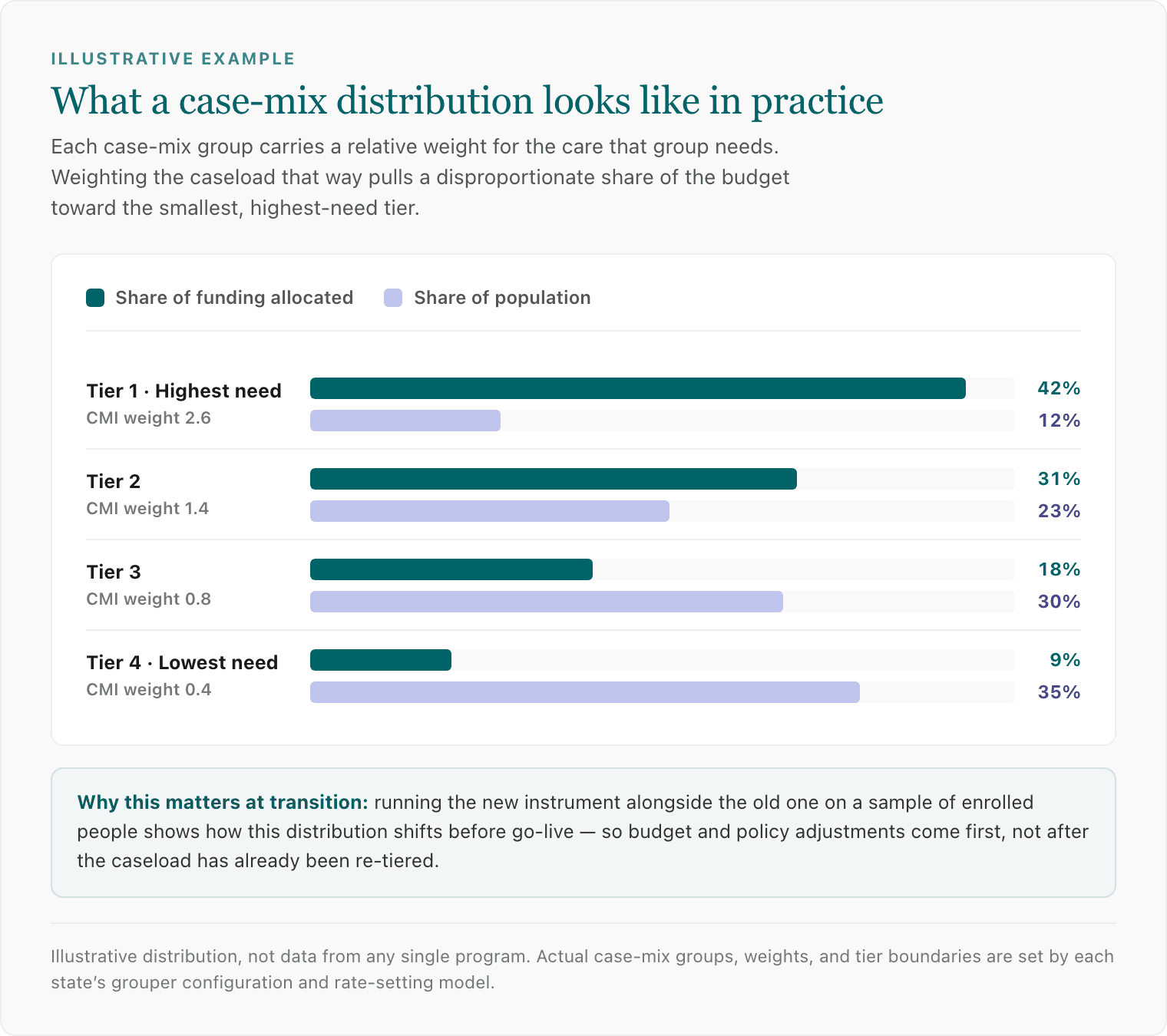
Perhaps the most consequential output for state LTSS administration is Case Mix. interRAI data feeds a case-mix grouper that assigns each person to a Case-Mix Group. Each group carries a Case Mix Index (CMI), a relative weight for the care that group needs.
For state programs, CMI has direct operational applications: it can inform budget allocation, provide a foundation for rate-setting in managed LTSS, and generate population-level data needed to model how caseload composition is changing over time.
When a state is transitioning from one assessment tool to another, CMI comparisons allow program leadership to model what the new tool would produce for their existing caseload before going live, so that policy and budget decisions can be made based on real projected data rather than assumptions.
Quality Indicators
At the population level, interRAI data enables Quality Indicators (QIs): system-wide benchmarking metrics that measure rates of key clinical and functional outcomes across a program. QIs are risk-adjusted, so state agencies can compare outcomes across providers, regions, and time periods. In countries with national interRAI deployments, QIs have become the primary mechanism for long-term care quality oversight.
What This Means for Program Administration
interRAI is not just a data collection form. It is a clinical decision support system, an outcomes measurement platform, a resource allocation tool, and a quality oversight mechanism, all built from the same assessment data. States that implement interRAI are not merely upgrading their assessment instrument. They are gaining an infrastructure that supports almost every function in an LTSS program that depends on knowing who is being served and how their needs are changing.
What interRAI Produces: Use Cases for State LTSS Programs
States evaluating interRAI are right to ask: beyond clinical validity and international adoption, what does this actually produce for my program? The answer depends on what a program needs, but five use cases emerge consistently across programs that have implemented interRAI.
Use Case 1: Level-of-Care Determination and Eligibility
At the most foundational level, interRAI provides a structured, validated basis for determining who qualifies for HCBS services. The assessment data drives clinical scoring (ADL Hierarchy, CHESS, Cognitive Performance Scale) that can be mapped to state-defined level-of-care criteria. Because the scoring is algorithmic, the same coded answers always produce the same scores. Consistency then rests on assessor reliability.
For states that face challenges with inconsistency in eligibility determinations, where the same person might qualify in one county but not another, interRAI’s structured assessment-to-eligibility pathway is a meaningful improvement.
What this looks like for an individual: A 74-year-old woman applies for home care services after a hospitalization. Her interRAI HC assessment finds she needs hands-on assistance with personal hygiene, toilet use, and moving around her home (ADL Hierarchy score of 3), has low health instability (CHESS score of 2), and shows mild cognitive impairment (Cognitive Performance Scale score of 2). The state’s level-of-care rules read those scores and set her tier of services.
Use Case 2: Service Planning and Authorization
CAPs identify clinical risk areas that should drive care planning discussions. Rather than leaving service plan content to assessor discretion alone, CAPs create a structured bridge between what was found in the assessment and what should be addressed in the plan. For states operating under managed care contracts or compliance requirements tied to person-centered planning, this embedded decision support reduces both clinical risk and documentation risk.
What this looks like for an individual: A 38-year-old man with an intellectual disability completes an interRAI ID assessment. When the assessment is finalized, his Depression Rating Scale flags depressive indicators, his Pain Scale flags untreated pain, and the Mental Illness CAP triggers. His support coordinator now has all three documented and can address them in the care plan. Without this flag, the pain and mood indicators might have been noted in the assessment but never translated into a care planning action. The CAP creates accountability that travels from the assessment into the service plan.
Use Case 3: Case-Mix-Based Budget and Rate Modeling
CMI scores enable state agencies to understand the relative need intensity of their population, not just headcount or total expenditure. This has direct applications for resource allocation: identifying underfunded segments of the caseload, modeling the fiscal impact of population aging or changing acuity, and setting rates that reflect actual support intensity rather than historical spending patterns.
States transitioning from older tools often use CMI modeling to project how their population distribution will shift under a new assessment instrument before they go live, allowing policy and budget adjustments to precede rather than follow the transition.
What this looks like for an individual: A participant who has been enrolled in the waiver for four years undergoes her annual reassessment. Compared to her prior assessment, her ADL function has declined and her health instability has increased. Her CMI score moves from a lower-acuity case-mix group to a higher one. Her recommended budget adjusts accordingly, reflecting her current level of need rather than what was documented four years ago.
Use Case 4: Population-Level Quality Measurement
Quality Indicators derived from interRAI data allow state programs to monitor clinical and functional outcomes at scale. What proportion of enrolled individuals show declining ADL function? What is the prevalence of pain that is not being treated? How many people with high CHESS scores have care plans that address their medical complexity? These questions cannot be answered from administrative claims alone. They require structured clinical assessment data, which is precisely what interRAI produces.
For states under CMS Enhanced Oversight requirements, or those building out their HCBS quality management programs, interRAI QIs provide a defensible, evidence-based measurement framework.
Use Case 5: Cross-Program and Longitudinal Analytics
Because interRAI instruments share a common data model, states that implement interRAI across multiple programs (aging/disability and I/DD, for example) can analyze their LTSS population as a whole. What is the relationship between assessed need and service utilization across waiver types? How do individuals’ needs change over time? Are high-need individuals receiving proportionally more services?
These are questions that state-specific tools, built in silos, cannot answer. interRAI’s integrated architecture makes them answerable.
interRAI vs. SIS and ICAP: A Comparison for I/DD Programs
For state I/DD waiver programs, selecting an assessment instrument is not merely a technical decision. It reflects a state’s underlying policy framework for defining disability and support needs. The assessment landscape in state I/DD programs has long been dominated by two instruments: the Supports Intensity Scale (SIS), published by the American Association on Intellectual and Developmental Disabilities (AAIDD), and the Inventory for Client and Agency Planning (ICAP).
Understanding why requires understanding what each tool does and where it stops.
What SIS Does: The Social and Support Needs Model
The SIS is built on the construct of extraordinary support needs: measuring how much assistance a person requires across life domains to participate fully in community life. The SIS-A (adult version) assesses 57 support need items across seven life activity areas, alongside supplemental medical and behavioral sections.
- Primary strength: The SIS excels at capturing the intensity, frequency, and daily type of support needed for community inclusion, employment, and independent living. Its normative data draws from over 150,000 assessments, and it is deeply familiar to the I/DD advocacy community and workforce.
- Core limitation: The SIS intentionally focuses on environmental and task-based support needs rather than deep clinical status. For individuals with complex medical conditions, severe behavioral health needs, or age-related functional decline, the SIS provides an incomplete picture of medical risk and health instability.
- Governance and IP structure: AAIDD owns the intellectual property and mandates state compliance with its published editions, manuals, and online platforms. The release of the SIS 2nd Edition in 2023 required states to execute re-norming studies and cut-off adjustments, a process driven by the publisher rather than state-led data models.
What ICAP Does: Adaptive Behavior Measurement
The ICAP focuses on adaptive behavior and problem behavior. It is a shorter instrument, less comprehensive than the SIS, and is used in states where the SIS has not taken hold. While clinically accepted, the ICAP has limited recent research investment and aging data infrastructure. It shares the SIS’s limitation of not capturing health complexity in meaningful depth.
What interRAI ID Does Differently: The Integrated Health and Clinical Risk Model
Transitioning from the SIS to interRAI ID is not a direct swap of like-for-like tools; it represents a philosophical shift from a pure supports model to an integrated clinical and risk-management model.
- Integration of medical and support domains: The interRAI ID captures comprehensive health parameters, including medical diagnoses, polypharmacy, skin integrity, nutritional decline, and pain, alongside daily functional and behavioral support needs. For an aging I/DD population with rising rates of complex medical comorbidities, this bridges the gap between medical health and community waiver services.
- Embedded clinical decision support: Through algorithm-generated Clinical Assessment Protocols (CAPs) and validated scales (such as CHESS for medical instability and CPS for cognitive performance), interRAI ID systematically flags clinical risks (e.g., aspiration risk, sudden functional decline, untreated pain) that support-only instruments are not designed to detect.
- Multi-population and cross-setting continuity: Because interRAI ID shares a core data architecture and item-level coding system with interRAI HC (Home Care) and LTCF (Long-Term Care Facility), states operating interRAI can analyze population health, transitions, and acuity across both aging/disability and I/DD waiver programs using a single analytical framework.
- Governance via research consortium: While interRAI, Inc. holds copyright over its instruments and requires formal licensing agreements, it is governed as an international nonprofit research network. Updates to items and algorithms are driven by peer-reviewed academic research rather than a single commercial publishing strategy.
Balancing the Paradigms
State administrators must recognize the trade-offs:
| Assessment dimension | Supports Intensity Scale (SIS) | interRAI Intellectual Disability (ID) |
|---|---|---|
| Underlying framework | Social model: focuses on environmental accommodations and community inclusion needs. | Clinical and integrated model: focuses on medical complexity, risk identification, and functional health. |
| Primary strength | Granular specificity for daily living activities, community integration, and employment planning. | Embedded clinical decision support (CAPs), cross-population data standardization, and longitudinal outcome tracking. |
| Health and medical depth | Minimal; captures supplemental medical flags but does not track clinical acuity or health risk trends. | Comprehensive; integrates medical conditions, stability metrics, medications, and clinical risk flags directly. |
| Implementation challenge | High licensing reliance on a commercial publisher; lacks cross-program compatibility with aging waivers. | Requires workforce retraining on clinical and functional scoring; building state-specific case-mix (CMI) funding tiers requires local modeling. |
A transition to interRAI ID shifts a state’s LTSS strategy toward holistic health management and cross-program alignment. However, states taking this route must ensure their care planning processes preserve the person-centered, community-first values that tools like the SIS were specifically created to safeguard.
Current LTSS Landscape: Where Things Stand Today
The Assessment Tool Landscape by Population
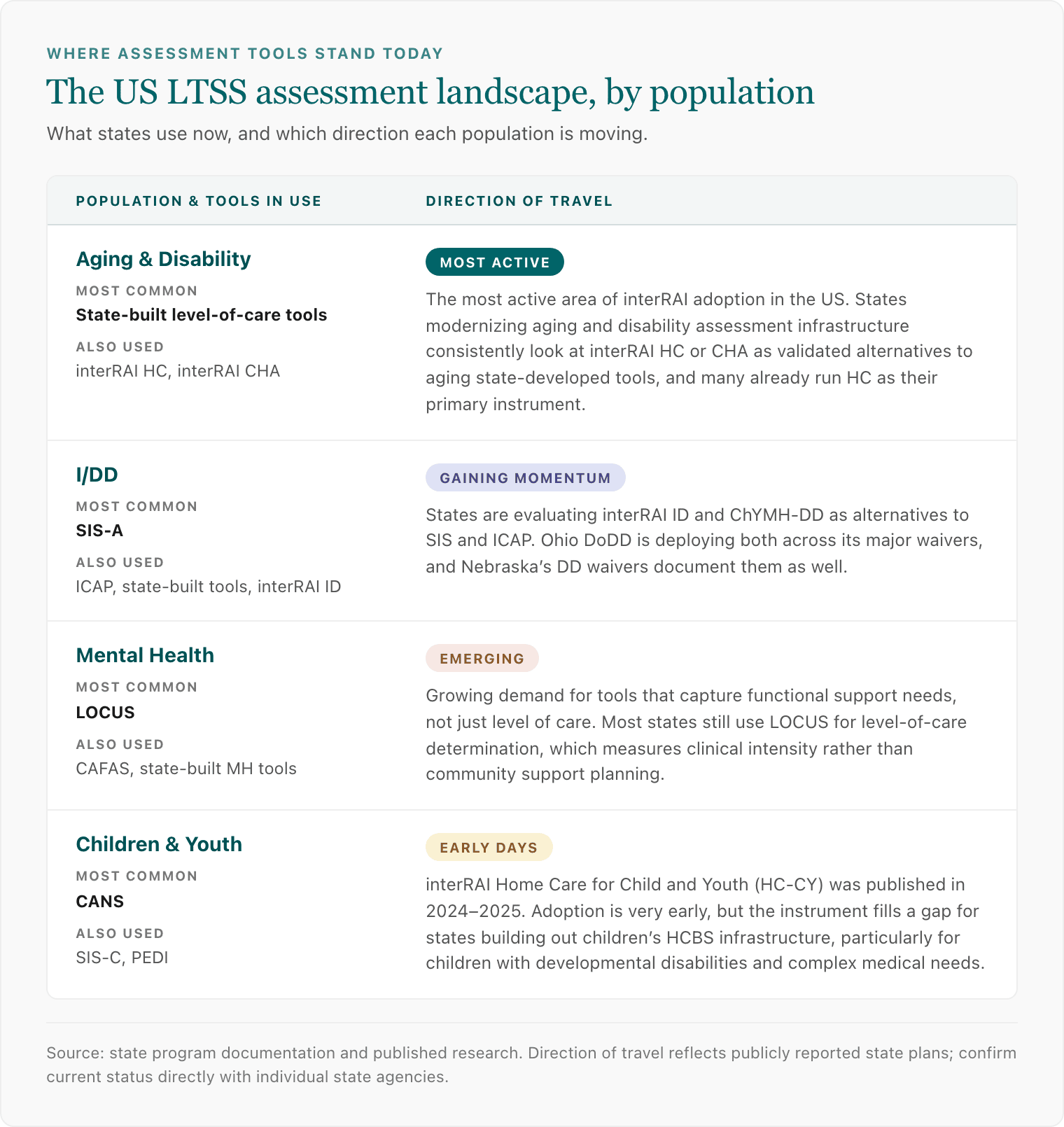
The reference card below summarizes the current assessment tool landscape across HCBS populations in the United States, including the direction states are moving. It reflects available research and state program documentation; verify current status with individual state agencies.
The interRAI Instrument Suite in Context
The instruments available from interRAI map directly to the populations and settings most common in Medicaid LTSS:
For aging and disabled HCBS waivers: interRAI HC is the primary instrument, covering the full clinical and functional domain set needed for home care. The Contact Assessment can serve as an initial screening instrument. The Check-Up enables shorter periodic re-assessments between full HC cycles.
For I/DD HCBS waivers: interRAI ID is the core instrument, with the ChYMH-DD instrument extending coverage to children and youth with developmental disabilities and co-occurring mental health conditions.
For mental health HCBS: interRAI CMH covers adults with serious mental illness in community settings.
For institutional-to-community transitions (MFP): The interRAI LTCF and HC instruments share a common data model, making interRAI a natural fit for Money Follows the Person programs where the same person needs to be assessed across settings.
For managed LTSS programs: interRAI HC and CHA, combined with the CMI outputs, provide the structured data that MLTSS contracts increasingly require.
What’s Driving Change: Why States Are Evaluating Their Assessment Tools
No state undertakes an assessment tool transition lightly. The operational disruption is significant, the costs are real, and the politics are not simple. When states are actively evaluating alternatives to their existing tools, there are almost always structural forces in play beyond dissatisfaction with the assessment itself.
Federal Alignment and the CMS Access Rule
The Centers for Medicare and Medicaid Services published updated HCBS access rules that, among other requirements, push states to better document the connection between assessed need and funded services. While the Access Rule does not mandate a specific assessment instrument, it creates regulatory pressure toward more structured, defensible, and consistent assessment processes. States using informal or fragmented assessment approaches face greater compliance risk under this framework. Standardized, validated instruments like interRAI provide a more defensible foundation.
Consistency in Resource Allocation
One of the most persistent challenges in LTSS administration is variation: the same person, presenting with the same needs, may receive different service authorizations depending on which assessor conducts the evaluation, which county they live in, or which program they happen to enter through. This inconsistency is not just an administrative inconvenience. It is a fairness problem, a legal risk, and a budget management problem.
Standardized assessment tools create a common basis for budget and service allocation decisions. When assessors across a state are using the same validated instrument and scoring algorithms, the resulting service plans and authorizations reflect documented need rather than assessor discretion. For state program administrators who are accountable to legislatures, CMS, and the people they serve for how Medicaid dollars are allocated, this consistency is a meaningful governance improvement.
But a standard instrument standardizes the questions, not the decision. The state writes the scoring logic that turns answers into an eligibility finding or a budget, and that is where the consequential choices live. Under the scoring rules they released in 2025, the District of Columbia and Missouri both run interRAI HC for nursing-facility level of care, and reach opposite conclusions about the same person: DC’s scoring matrix reads no cognition item at all, while Missouri treats severe cognitive impairment as automatic qualification.
Cross-Population and Cross-Setting Continuity
A significant limitation of the current fragmented landscape is that the same individual may be assessed by completely different tools depending on which program they are in or where they receive services. A person with an intellectual disability who ages into a co-occurring physical disability may be assessed by an I/DD-specific instrument for one program and an entirely different aging-focused tool for another, producing data sets that cannot be compared or integrated.
Similarly, individuals transitioning from institutional settings to community care (through Money Follows the Person or other transition programs) are typically assessed with completely different instruments on each side of the transition, losing clinical context and continuity in the process.
interRAI’s cross-setting, cross-population design addresses both problems directly. A person can move from a nursing facility (LTCF instrument) to home care (HC instrument) to a periodic check-in (Check-Up instrument), with each assessment drawing from the same data model and contributing to a longitudinal picture of their needs. A state operating interRAI ID and interRAI HC simultaneously can analyze individuals who receive services under both programs within a unified framework. That kind of integration is structurally unavailable to programs built on siloed, population-specific tools.
Population Complexity
The HCBS waiver population has grown significantly in recent years, both in total enrollment and in the complexity of needs being served. Individuals who previously would have been served in institutional settings are increasingly living in the community, often with significant medical, behavioral, and functional needs. Assessment tools designed for earlier eras of community services may not capture this complexity well. Program administrators who cannot see their population’s clinical complexity in their assessment data cannot make sound resource allocation decisions.
Data and Analytics Expectations
State LTSS programs are under increasing pressure to demonstrate outcomes, from CMS, from legislatures, from advocacy communities, and from managed care partners. Outcome measurement requires structured data. Programs built on paper-based, locally customized, or analytically thin assessment tools cannot produce the quality indicators, outcomes benchmarks, and population trend analyses that modern LTSS accountability requires. interRAI’s structured data architecture is purpose-built for this kind of analytics.
Proprietary Tool Costs and Control
The SIS licensing model has become a pressure point in states across the country. When AAIDD released the SIS 2nd Edition in 2023, states were required to update their normative cutoffs, a change that affected who qualified for what level of services, with direct fiscal implications. States had no vote in that decision. Several have begun asking publicly whether the long-term cost of depending on a proprietary tool, in pricing, platform dependence, and loss of analytical control, is a sound policy position.
Federal Managed LTSS Trends
As more states move LTSS into managed care arrangements, the need for standardized, reliable assessment data increases. Managed care contracts increasingly require states to demonstrate that enrollment and service authorization decisions are rooted in documented, validated assessment findings. A state LTSS program that cannot produce that evidence is at a disadvantage in both federal oversight conversations and in negotiating managed care contract terms.
What It Takes to Implement interRAI in Your Program
The clinical and policy case for interRAI is often what draws state leadership to the conversation. The implementation realities are what make or break the transition. States that have navigated interRAI adoption successfully share a common understanding: this is a multi-year undertaking that requires planning across policy, workforce, technology, and data systems simultaneously.
Training and Workforce Development
Workforce readiness is one of the most underestimated elements of an interRAI implementation. Getting the technology right matters; getting people ready to use it correctly matters at least as much, and the two workstreams have to run in parallel.
Who can administer interRAI assessments. The clinical demands of the instrument vary by which instrument a state is implementing. For example, the interRAI HC is designed for clinical assessors, typically registered nurses or other trained clinicians, because it asks assessors to make clinical observations and judgments across health, cognition, functional, and behavioral domains. This is a meaningful departure from the lighter-touch tools many states currently use, where case managers or social workers conduct assessments without clinical credentialing requirements. States transitioning to interRAI HC will need to evaluate their existing assessor workforce, determine whether clinical capacity exists at the needed scale, and plan recruitment accordingly before go-live.
The interRAI ID instrument has more flexibility in who can administer it depending on state policy, though all interRAI instruments require structured training and demonstrated scoring reliability before assessors conduct independent assessments.
The role of interRAI Fellows in training. interRAI Fellows are an international network of over 135 leading researchers, clinicians, and policy experts who develop, test, and implement standardized health assessment systems for vulnerable and older populations. Their function is primarily scientific: they refine the instruments, produce the research base that validates them, and contribute to the training curriculum and manuals that accompany each instrument. Fellows are key partners in the training process. For example, Melanie Thomasson with HCBS Strategies is a protégé of interRAI co-founder Brant Fries, sits on the interRAI Scientific Committee, and also consults directly with states on their interRAI implementations. In addition to doing direct training of staff, interRAI Fellows can offer Train-the-Trainer curriculum so states can continue to keep standards high. HCBS Strategies also runs the Enhancing interRAI initiative, which coordinates multi-state support for interRAI instruments, workforce training, care coordination, and outcomes measurement, and is the clearest sign that US-focused implementation infrastructure is maturing beyond one-off state projects.
What training involves. interRAI training is not a short orientation. For the HC instrument in particular, initial training typically runs 40 to 80 hours and combines self-paced learning (using interRAI-developed curriculum materials and manuals), in-person or virtual instruction covering how to code instrument items consistently, and reliability testing using case vignettes or scored exercises. Assessors are evaluated on whether their coding of a standardized case matches expected responses within an acceptable threshold before they are cleared to conduct assessments independently. This is not a pass-fail certification administered by interRAI centrally; it is a reliability standard that states set and monitor within their own programs, typically guided by interRAI’s implementation documentation.
Train-the-trainer as a scaling strategy. That Train-the-Trainer curriculum matters most at scale, when a state has dozens or hundreds of assessors distributed across regions and no external partner can conduct every training session indefinitely. The practical approach, used in jurisdictions with established interRAI programs, is to build internal training capacity: a core group of staff who receive intensive training, develop deep familiarity with the instrument and its coding rules, and are then responsible for training and supporting new assessors going forward. Identifying who will carry that internal role, and investing appropriately in their preparation, is a workforce planning decision that should be made during implementation design rather than after the instrument is live.
Ongoing reliability monitoring. Initial training is necessary but not sufficient. Assessor reliability, meaning the consistency of scoring across different assessors evaluating the same situation, is the variable that determines whether interRAI data is actually comparable across a program. If assessors interpret items differently, the structured data interRAI produces loses its value for population-level analysis and clinical decision support. States should build in recurring reliability monitoring: periodic checks that compare assessor scoring patterns, identify systematic variation, and trigger retraining when drift is detected. Some programs use ongoing case review processes or periodic scored vignettes for this purpose. The important thing is that reliability monitoring is a planned, sustained function, not a one-time post-launch check.
Conformance and Licensing
interRAI instruments are available for implementation under a licensing agreement with the interRAI consortium. Implementation must meet conformance requirements, including the “5% rule,” which governs how many items can be modified from the standard instrument while maintaining the ability to compute interRAI algorithms and scales. States that want to add program-specific items can do so, but those items must be designed carefully so they sit alongside the interRAI items without disrupting algorithmic computation.
Conformance details are typically worked out in collaboration with interRAI and implementation partners before configuration begins. This pre-work is not optional; it determines what the final instrument can compute.
Technology Infrastructure
interRAI cannot be implemented on paper. The instruments are too long, the algorithms too complex, and the data outputs too structured for manual processes. States need a technology platform capable of administering assessments in field settings, computing CAPs and scales in real time, storing item-level data in a format that supports population-level analysis, and exporting data for reporting and integration with other state systems.
This technology requirement is one of the most significant implementation constraints for states that do not have an existing assessment management platform. Building custom assessment software is a multi-year undertaking that has consistently proven more complex and expensive than projected, due to the sophistication of the interRAI data model and the algorithm supply chain required to keep instruments current.
Working with a technology vendor that has pre-built interRAI capability, and has already navigated conformance and algorithm integration, dramatically compresses the implementation timeline and reduces technical risk.
Policy and Regulatory Alignment
A new assessment instrument touches virtually every policy document in an LTSS program: eligibility criteria, level-of-care standards, service authorization processes, care planning requirements, provider contracts, and quality measurement frameworks. States that implement interRAI without updating these downstream policy documents create inconsistencies between what the assessment produces and what the program is designed to do with those outputs.
Policy alignment work, including analysis of whether interRAI-derived scores map correctly to existing level-of-care thresholds, should begin in the planning phase, not after the technology is built.
CMI Transition Modeling
When a state transitions from one assessment tool to another, the distribution of participants across need levels will change, not because the population changed, but because the new instrument measures needs differently. Some individuals will score higher; others lower. This shift has direct fiscal implications for service authorization budgets.
States that have navigated this successfully have done CMI transition modeling before eliminating the old assessment: running parallel assessments on a sample of enrolled individuals using both the old and new instrument, comparing the population distributions, and adjusting policy accordingly. This is a resource-intensive but necessary step for responsible fiscal management.
State Spotlights: interRAI in Action
New York: The UAS-NY and the Largest US Deployment
New York’s Uniform Assessment System (UAS-NY) is the most significant US implementation of interRAI to date. Built directly on the interRAI Home Care instrument, the UAS-NY is required for all individuals seeking Medicaid home care services or managed long-term care enrollment in New York State.
The UAS-NY is administered by independent assessor organizations contracted by the state Department of Health. It drives eligibility determination, care planning, and managed care enrollment decisions for New York’s managed long-term care (MLTC) program. New York’s experience has generated the largest US evidence base for interRAI HC implementation at scale, including data on assessor reliability, population distribution, and operational workflow.
The UAS-NY also established a regulatory precedent: CMS accepted an interRAI-based instrument as the foundation for a state’s LTSS assessment process. That acceptance reduced a significant source of uncertainty for other states evaluating interRAI adoption.
Ohio DoDD: Transitioning I/DD Waiver Infrastructure to interRAI
The Ohio Department of Developmental Disabilities (DoDD) represents one of the most prominent state transitions toward interRAI in the I/DD sector. As part of a broader waiver modernization initiative, Ohio DoDD is deploying the interRAI ID and interRAI ChYMH-DD instruments across its major Medicaid waivers. The transition replaces legacy assessment mechanisms, such as the Ohio Developmental Disabilities Profile (ODDP) and the Acuity Assessment Instrument (AAI), with a standardized, needs-based framework designed to enhance person-centered planning. By adopting interRAI tools, DoDD aims to simplify authorization processes while systematically capturing daily living skills, behavioral risks, and complex physical health needs across its statewide developmental disabilities support system.
International Reference Points
For states looking for evidence of interRAI at scale, the international deployments provide the strongest evidence base.
Canada uses interRAI Home Care as the standard instrument for home care data collection, with the Canadian Institute for Health Information (CIHI) managing national interRAI data and providing implementation resources to health organizations. Canada’s deployment represents the largest and longest-running interRAI home care implementation in the world, and the CIHI’s annual reporting on home care quality provides a model for what population-level interRAI data can produce at scale.
Australia adopted interRAI HC as part of its aged care reform agenda following the Royal Commission into Aged Care Quality and Safety. The national rollout, underway since 2022, provides a real-world reference for large-scale implementation logistics, assessor training at scale, and government-wide data integration.
New Zealand became the first country in the world to mandate interRAI assessments nationally, with aged residential care facilities required to use interRAI from July 2015. interRAI New Zealand operates as a business unit within Health New Zealand (Te Whatu Ora), and is licensed to administer six interRAI instruments across settings: Contact Assessment, Home Care, Community Health Assessment, Long-Term Care Facilities, Acute Care, and Palliative Care. New Zealand’s experience is instructive for how a national deployment handles instrument versioning, training reliability, and data integration across a unified health system.
How Technology Platforms Support interRAI Implementation
Assessment tool decisions and technology decisions are inseparable. The instruments that interRAI produces are too complex, with too many items, too many computed outputs, and too much data, to administer without purpose-built software. The software decisions a state makes will determine not just how assessment goes, but how long implementation takes, how much it costs, and how much clinical value the program actually extracts from the data.
The core technology requirements for interRAI are: field-administered assessment management, real-time algorithm computation (CAPs, scales, CMI), structured data storage, reporting and population analytics, and integration with other state data systems (case management, billing, quality oversight).
States have three paths for meeting these requirements: build custom assessment software, adapt an existing platform, or work with a vendor that has pre-built interRAI capability.
Custom development is the path most likely to underestimate complexity. The interRAI data model is sophisticated. Algorithm computation, the CAPs and scales that make interRAI clinically useful, requires both the technical infrastructure to run the algorithms and a formal supply chain for obtaining, testing, and updating those algorithms as instrument versions change. States that have built custom interRAI tools have consistently taken longer and spent more than projected.
Adapting existing case management platforms to support interRAI is common but variable. Many general-purpose case management systems can be configured to display interRAI items, but few are built to compute interRAI algorithms natively, manage instrument versioning, or produce the structured data outputs that population analytics require.
Platforms designed specifically for interRAI implementation, built with the data model, algorithm integration, and assessment workflow already in place, represent the fastest path to clinical value from the assessment data.
Mon Ami has built native support for the core interRAI instrument suite through our Enhanced Assessments module, including Home Care (HC), Intellectual Disability (ID), ChYMH-DD, Contact Assessment (CA), Check-Up, and others. Every assessment field is mapped to interRAI iCODE standards, enabling algorithm computation to run in real time against standardized item-level data. CAPs, scales, need scores, and key findings are surfaced automatically in an assessment summary after each completed assessment, with no manual scoring required.
The algorithms themselves are supplied by interRAI, not authored by Mon Ami. An independent quality assurance process, conducted by third-party researchers, verifies that the computed outputs match interRAI’s reference outputs and behave as expected across piloted populations before any instrument goes live. This combination of external algorithm supply and independent verification is what makes Mon Ami’s implementations interRAI-conformant rather than interRAI-adjacent.
Offline-capable field assessment. One of the most practical barriers to interRAI adoption is connectivity. interRAI assessments are conducted in the field, in people’s homes, group facilities, and community settings, where internet access is often unreliable or absent. If assessors cannot complete the assessment digitally in the field, they revert to paper, losing the real-time algorithm computation that is the primary clinical value of digital interRAI. Paper workarounds also create significant data entry backlogs and error risk.
Mon Ami is built to operate fully offline. Assessors can conduct a complete interRAI assessment in the field without any internet connection. The CAPs, scales, and summary findings compute locally on the device as items are entered, so the assessor has full clinical decision support in the moment, not after syncing later. Once the device reconnects, the assessment data syncs automatically. This offline capability is not a feature add-on; it is a foundational design requirement for an interRAI platform built around real-world field conditions.
For frontline assessors, Mon Ami also includes a built-in instrument manual that makes clinical guidance available within the assessment interface, progress tracking so assessors know exactly where they are in a long instrument, and automated summary generation that immediately reflects what the data found without additional documentation steps.
Mon Ami is currently active with interRAI implementations in Ohio (interRAI ID and ChYMH-DD), Hawaii (Check-Up and Contact Assessment), and Alaska (Home Care). See our Enhanced Assessments page for more information about Mon Ami’s tools supporting interRAI.
A Note on the Limits of Standardized Assessment
Any serious discussion of interRAI, or of assessment tools in LTSS generally, has to include a true accounting of what standardized assessment can and cannot do. Leaders who adopt interRAI for the right reasons, with clear eyes about its limitations, are better positioned to use it well than those who approach it as a solution to problems it was never designed to solve.
It Is Not Objective
The word “objective” gets applied to validated assessment instruments more often than it should. interRAI items are based on clinical observation and structured response categories, but the observations themselves require judgment. An assessor’s determination of whether a person’s memory is “intact,” “moderately impaired,” or “severely impaired” draws on training, experience, and contextual interpretation. The algorithm that computes the CAP or scale score is deterministic once the items are recorded. The items themselves are not.
This is not a weakness unique to interRAI. It is a feature of all clinical assessment. What interRAI provides is a structured, consistent framework for exercising that judgment, one built on 35 years of research, validated across populations and settings, and designed to reduce idiosyncratic variation. That is not the same as objectivity. It is rigor within the bounds of what clinical assessment can be.
States that implement interRAI expecting that it will eliminate assessor judgment have misunderstood the tool. States that implement it understanding that it disciplines and systematizes that judgment, while surfacing risks that judgment alone might miss, will use it more effectively.
It Is Not Equitable, But It Is Consistent
This distinction is important and worth stating directly. Equity and consistency are not synonyms. A consistent process treats every person the same way. An equitable process produces fair outcomes. These are related but not identical goals, and the gap between them matters.
interRAI applies the same items, the same scoring algorithms, and the same clinical protocols to every person assessed. In that sense, it is remarkably consistent. CMS’s own language around standardized assessment emphasizes this: the benefit of a standardized instrument is consistency of process.
But consistency does not guarantee equity. If the items in an assessment instrument were developed from clinical populations that did not proportionally represent certain communities, including people of color, people whose primary language is not English, or people whose cultural context of support and family structure differs from the normative sample, then applying those items consistently can produce consistently biased results. The output will be consistent. It will not necessarily be equitable.
This is not a reason not to use interRAI. It is a reason to use it with awareness. States that implement interRAI should build in mechanisms to monitor assessment outcomes by demographic group, flag patterns that suggest systematic variation in scoring, publish the scoring logic, and invest in assessor training that addresses cultural competency alongside clinical content. The instrument is a tool. How it is used, by whom, and with what attention to the communities it serves, determines whether it moves a program toward more equitable outcomes or merely more consistent ones.
The Fundamental Tension in Any Assessment Tool
There is an inherent limitation in any attempt to capture human need in a structured instrument. Real needs are multidimensional, contextual, relational, and changing. Assessment instruments are bounded, categorical, static at the point of capture, and filtered through the lens of what items the instrument’s developers decided to ask.
This does not make interRAI less useful. It makes it what it is: a structured approximation of complex human reality, built from the best available evidence, designed to support better decisions than no structured assessment would produce. The goal is not to replace clinical judgment, person-centered conversation, and family context with a score. The goal is to give those conversations a consistent analytical foundation, and to ensure that what is found in the assessment has a pathway to action in the care plan.
Leaders who hold that understanding are better equipped to use interRAI well, to explain its value honestly to stakeholders, and to build the complementary systems (person-centered planning processes, cultural competency frameworks, outcome monitoring) that determine whether the tool’s outputs translate into better lives for the people being served.
Conclusion
interRAI has moved from an international research initiative to a practical policy question for US state LTSS administrators. The combination of federal access rule pressure, growing frustration with proprietary tool licensing, and the demonstrated track record of interRAI in large-scale deployments abroad and in the United States has brought assessment modernization to the top of the agenda in state Medicaid agencies across the country.
The case for interRAI rests on several compounding advantages: a multi-population instrument family that can serve aging, disability, I/DD, and mental health programs within a single framework; clinical decision support embedded in the data collection process itself; a research base spanning 40 countries and decades of peer-reviewed literature; a nonprofit ownership model that eliminates single-vendor lock-in; and a growing infrastructure of US-focused implementation support, including the interRAI Fellows and the HCBS Strategies–led Enhancing interRAI initiative described above.
None of that makes implementation simple. The technology requirements are substantial. The workforce development investment is real. The policy alignment work touches every corner of how an LTSS program operates. And the CMI transition modeling, done correctly, requires resources and expertise that most state agencies do not have in-house.
The states that are moving forward now are not doing so because interRAI is perfect. They are moving forward because the status quo, fragmented tools, proprietary licensing, siloed data, and assessment systems that were not built to answer the questions that modern LTSS programs must answer, is no longer adequate for the populations they serve or the accountability expectations they face.
For state LTSS leaders who are at the beginning of that evaluation, the questions worth asking are: What would a responsible transition look like for our program? What partners and infrastructure do we need to do it well? And what will we be able to see, and do, and measure about the people we serve that we cannot see today?